


Monday, April 6, 2009
New Pictures
I have added pictures to some of my March blogs. Take another look at Refilwe, Picture Books and Macaroni and Cheese, and Alexandra Grannies.


Friday, April 3, 2009
Imelda's
One day last week I went back with Ruth to Imelda's in Alex. We took cakes to serve a group of businessmen coming to look at the grannies support project with a view to getting involved financially. While Ruth and Imelda talked in her small combination living room and kitchen, I enjoyed the sunshine outside.
I counted eight doors opening onto Imelda's courtyard. Ten doors opened into the neighboring courtyard where three little girls played with a naked babydoll. Imelda's house has three rooms and running water. Many don't. In the middle of each courtyard was an small, sheet metal building that reminded me of an old-fashioned outhouse. That's what it was, only these outhouses had flush toilets--one per courtyard. Behind each outhouse was a tap over a wash tub for everyone in the courtyard to use.
Imelda took us to visit a pregnant teen. We left the car in the stony courtyard of a tuck shop/bar. Imelda led us down a narrow ally with a gutter of putrid water running down the middle to the shack where the girl lived. The girl's father was there, as was her sister, and her sister's two small children--one a darling little girl with a pink T-shirt and a charming smile. The room can't have been larger than nine feet by twelve, but it was cramped with a fridge, a small chest freezer with a microwave on top, a tiny, black and white television and an oven/two burner cooking unit on a chest of drawers. The lounge furniture on which we sat consisted of a backless wooden bench in front of the curtain that separated the bedroom.
We walked out into the street for a little privacy. Ruth asked the girl about her first pre-natal visit to the doctor. It had not been a positive experience. Imelda will offer to go with her next time. Ruth promised to help with baby clothes when the time comes--a small token of hope in a desperate situation.
Imelda is concerned about her teenage son. She has talked with him about her own status and the dangers of promiscuity. He shakes his head. He isn't willing to postpone sexual gratification until he finds a life partner. I wonder about this teenage girl. She may have never slept with anyone except the father of her baby, but how many women has he slept with? What is his HIV status? How can we convince teens that sex is worth waiting for?
I counted eight doors opening onto Imelda's courtyard. Ten doors opened into the neighboring courtyard where three little girls played with a naked babydoll. Imelda's house has three rooms and running water. Many don't. In the middle of each courtyard was an small, sheet metal building that reminded me of an old-fashioned outhouse. That's what it was, only these outhouses had flush toilets--one per courtyard. Behind each outhouse was a tap over a wash tub for everyone in the courtyard to use.
Imelda took us to visit a pregnant teen. We left the car in the stony courtyard of a tuck shop/bar. Imelda led us down a narrow ally with a gutter of putrid water running down the middle to the shack where the girl lived. The girl's father was there, as was her sister, and her sister's two small children--one a darling little girl with a pink T-shirt and a charming smile. The room can't have been larger than nine feet by twelve, but it was cramped with a fridge, a small chest freezer with a microwave on top, a tiny, black and white television and an oven/two burner cooking unit on a chest of drawers. The lounge furniture on which we sat consisted of a backless wooden bench in front of the curtain that separated the bedroom.
We walked out into the street for a little privacy. Ruth asked the girl about her first pre-natal visit to the doctor. It had not been a positive experience. Imelda will offer to go with her next time. Ruth promised to help with baby clothes when the time comes--a small token of hope in a desperate situation.
Imelda is concerned about her teenage son. She has talked with him about her own status and the dangers of promiscuity. He shakes his head. He isn't willing to postpone sexual gratification until he finds a life partner. I wonder about this teenage girl. She may have never slept with anyone except the father of her baby, but how many women has he slept with? What is his HIV status? How can we convince teens that sex is worth waiting for?
Monday, March 30, 2009
Refilwe
Refilwe means 'gift' in the Tswana language of southern Africa. The name also describes a Christian children's home north of Johannesburg. Some of the children are orphans, some are half-orphans and some have simply been removed from difficult situations by the state.
 Refilwe is run on the cluster foster-home plan. Carefully screened godparents bring their own children to live in one of the three-bedroomed brick houses strung like beads along the river bank. They share their home and family life with a handfull of foster children. Each household has it's own vegetable garden. The community also runs income generating projects like livestock and a plant nursery. The clinic and the creche serve the near-by informal settlement (squatter camp) giving all a chance at a better life.
I went to Refilwe to talk with godparents and teachers from the creche about (what else?) reading with children. The godmothers arrived first, and we had an informal time. Most of their children are school age; many are teens. We talked about turning off the television, reading aloud with the younger ones while the older ones listen in, leaving good books around for children to pick up, and modeling an eagerness to read. One of the godmothers mentioned a book her teens had been passing around that had led to spirited discussion--a good reason to promote reading among the children.
 When the creche teachers arrived, we discussed why read at all, and I demonstrated ways of involving small children in the story. They were thrilled with the books I brought as examples. Rosebank Union Church, who sponsored my visit, will work with them on a project to get books for the program.
The creche had been having story time once a week. "We could be reading three times a week," the director commented in the discussion afterward. "Or maybe even every day right before lunch." If she follows through, the lives of these children will be changed forever.

 Refilwe is run on the cluster foster-home plan. Carefully screened godparents bring their own children to live in one of the three-bedroomed brick houses strung like beads along the river bank. They share their home and family life with a handfull of foster children. Each household has it's own vegetable garden. The community also runs income generating projects like livestock and a plant nursery. The clinic and the creche serve the near-by informal settlement (squatter camp) giving all a chance at a better life.
I went to Refilwe to talk with godparents and teachers from the creche about (what else?) reading with children. The godmothers arrived first, and we had an informal time. Most of their children are school age; many are teens. We talked about turning off the television, reading aloud with the younger ones while the older ones listen in, leaving good books around for children to pick up, and modeling an eagerness to read. One of the godmothers mentioned a book her teens had been passing around that had led to spirited discussion--a good reason to promote reading among the children.
 When the creche teachers arrived, we discussed why read at all, and I demonstrated ways of involving small children in the story. They were thrilled with the books I brought as examples. Rosebank Union Church, who sponsored my visit, will work with them on a project to get books for the program.
The creche had been having story time once a week. "We could be reading three times a week," the director commented in the discussion afterward. "Or maybe even every day right before lunch." If she follows through, the lives of these children will be changed forever.

Saturday, March 28, 2009
New Life
It is in those major transitions of life that we missionaries most miss being 'home.' I remember my heartbreak when my grandfather was diagnosed with a terminal brain tumor. I missed his funeral and that of my grandmother. I also missed my brother's wedding.
I was present two years ago when my first grandchild was born, holding one of her mother's feet while her husband held the other and she pushed for all she was worth. I saw baby Isabella's thick, dark hair crowning. An indelible image is stamped on my brain of that tiny infant only minutes old, eyes scrunched shut, fists waving, complaining of the coldness and brightness of this new world as the nurse washed her. Where were the warm, secure walls of her mother's womb?
Bella's baby brother, Alexander Robert, arrived at 12:35 A.M. this morning. He is almost two weeks early--strong and healthy and eager to begin his new life. I talked to Katie a few hours later by Skype--a luxury my own mother in Indiana didn't have when Katie made her appearance in Campinas, Sao Paulo. Katie sounded alert and happy. She was busy bonding with the little fellow. Bella wasn't there yet and hadn't yet met her new brother. I wish I could see her eyes when she does. I keep trying to picture him and all I see is Bella, waving her tiny fists, or wrapped in a blanket with a little knit cap on her head.
Alexander wasn't supposed to come until the middle of April. I changed my original plans to spend April and May in Africa so that I wouldn't miss the event. I even moved my return flight up when his arrival seemed eminent, but it didn't work. I'll be with them in a few days. Am I disappointed that I'm not there now? Maybe a little. Mostly I'm just thrilled he's safely here!
I was present two years ago when my first grandchild was born, holding one of her mother's feet while her husband held the other and she pushed for all she was worth. I saw baby Isabella's thick, dark hair crowning. An indelible image is stamped on my brain of that tiny infant only minutes old, eyes scrunched shut, fists waving, complaining of the coldness and brightness of this new world as the nurse washed her. Where were the warm, secure walls of her mother's womb?
Bella's baby brother, Alexander Robert, arrived at 12:35 A.M. this morning. He is almost two weeks early--strong and healthy and eager to begin his new life. I talked to Katie a few hours later by Skype--a luxury my own mother in Indiana didn't have when Katie made her appearance in Campinas, Sao Paulo. Katie sounded alert and happy. She was busy bonding with the little fellow. Bella wasn't there yet and hadn't yet met her new brother. I wish I could see her eyes when she does. I keep trying to picture him and all I see is Bella, waving her tiny fists, or wrapped in a blanket with a little knit cap on her head.
Alexander wasn't supposed to come until the middle of April. I changed my original plans to spend April and May in Africa so that I wouldn't miss the event. I even moved my return flight up when his arrival seemed eminent, but it didn't work. I'll be with them in a few days. Am I disappointed that I'm not there now? Maybe a little. Mostly I'm just thrilled he's safely here!
Thursday, March 26, 2009
Picture books and Macaroni and Cheese
Two local grocery chains supply soon-to-be-out-of-date food to the Rose ACT programs. Wednesday Ruth brought a large cardboard box of frozen macaroni and cheese dinners from Pick and Pay to the grannies meeting.
 The Wednesday grannies are more in number than the group I met with at the Baptist church. There were 24 ladies and one gentleman. They usually meet under a sheet of plastic stretched across a junk-wood frame between two buildings, but the man who owns the space forgot to move his car this Wednesday morning. So the ladies lined up their plastic garden chairs along the wall of the neighboring house where the shadow fell a few feet into the brick drive.
Twenty-five people all in a row make quite a line. I stood in the sun and read my stories, walking from one end of the line to the other to be sure everyone saw the pictures and understood what was going on. Imelda, who might have translated, was busy heating the mac and cheese and despite their assurances, these ladies didn't seem as educated or fluent in English as the Friday group. I was less confident that they would understand someone merely standing up front talking in a language that wasn't their own. But they laughed appreciatively as Lulama tricked the baboons, the python and the lion and at last made her way home to her mother's arms. They nodded agreement when I explained my reasons for reading with their grandchildren.
When I had finished, one woman asked, "What do you do when the children are older and don't want to read?" Too often the TV stays on all the time, and modern young people don't want to listen to their granny. I will need to think through some appropriate suggestions for reaching the older ones.
I wish I could give every one of these grannies a $2 copy Our Gran. They cooed delightedly when I read it as an example of how a story can help to introduce a sensitive topic. It describes them and all they do for their families. Together they had 129 grandchildren and 49 great-grandchildren, although not all of those were living with the grandparents. And Ruth told me that the lady with the most grandchildren (23) wasn't even there!
Imelda and Selina brought plates of mac and cheese as fast as the capacity of Imelda's small oven allowed. I found a seat in the shade along the wall, reminding myself how nice the African sun should feel after a Northern winter, and how good my tan would look when I returned to Wisconsin. After all, at this altitude the sun isn't what it can be in the lowfeldt.
The woman next to me pulled a small plastic storage container out of her bag, and slid most of her portion of mac and cheese into it to take home.
"For my grand daughter," she explained, saving only the last couple bites for herself.
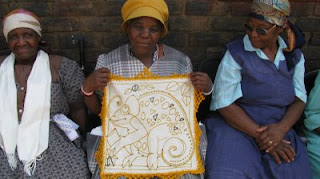
 The Wednesday grannies are more in number than the group I met with at the Baptist church. There were 24 ladies and one gentleman. They usually meet under a sheet of plastic stretched across a junk-wood frame between two buildings, but the man who owns the space forgot to move his car this Wednesday morning. So the ladies lined up their plastic garden chairs along the wall of the neighboring house where the shadow fell a few feet into the brick drive.
 Twenty-five people all in a row make quite a line. I stood in the sun and read my stories, walking from one end of the line to the other to be sure everyone saw the pictures and understood what was going on. Imelda, who might have translated, was busy heating the mac and cheese and despite their assurances, these ladies didn't seem as educated or fluent in English as the Friday group. I was less confident that they would understand someone merely standing up front talking in a language that wasn't their own. But they laughed appreciatively as Lulama tricked the baboons, the python and the lion and at last made her way home to her mother's arms. They nodded agreement when I explained my reasons for reading with their grandchildren.
When I had finished, one woman asked, "What do you do when the children are older and don't want to read?" Too often the TV stays on all the time, and modern young people don't want to listen to their granny. I will need to think through some appropriate suggestions for reaching the older ones.
I wish I could give every one of these grannies a $2 copy Our Gran. They cooed delightedly when I read it as an example of how a story can help to introduce a sensitive topic. It describes them and all they do for their families. Together they had 129 grandchildren and 49 great-grandchildren, although not all of those were living with the grandparents. And Ruth told me that the lady with the most grandchildren (23) wasn't even there!
Imelda and Selina brought plates of mac and cheese as fast as the capacity of Imelda's small oven allowed. I found a seat in the shade along the wall, reminding myself how nice the African sun should feel after a Northern winter, and how good my tan would look when I returned to Wisconsin. After all, at this altitude the sun isn't what it can be in the lowfeldt.
The woman next to me pulled a small plastic storage container out of her bag, and slid most of her portion of mac and cheese into it to take home.
"For my grand daughter," she explained, saving only the last couple bites for herself.

Saturday, March 21, 2009
Ubulhe Pre-school

The children were still at lunch when I arrived at Ubuhle Pre-school with Poppy, the Tembisa children's librarian. We sat on small wooden chairs in the main room. Through an open door we smiled at forty or more children seated at low tables, eating samp (hominy grits) and beans from bright plastic plates. As they finished, they came to greet us.
First came three little girls. They were probably four or five years old. Their hair was braided in tight cornrows. Two were obviously twins. "Good day," they said in turn, their brown faces exploding with grins as if they had dared one another to actually speak to the visitors in English.
"Good day," I said although it is not an expression I normally use. "How are you today?"
"I am fine," they replied in unison, pressing against the wall and dissolving in giggles.
A little boy came up the steps from the garage/lunch room. He held out his hand for me to shake. "Good day," he said clearly.
"Good day. And how are you?" I asked him.
His huge brown eyes went blank.
"Say, 'I. Am. Fine'," one of the little girls prompted him, enunciating each word separately.
"I. Am. Fine." He nodded his head with each remembered word.
After that they came more quickly, thrusting eager hands for Poppy and me to shake and reciting the words of greeting they had learned. Some needed prompting by the bigger girls. Some managed all by themselves.
While we waited for the stragglers to finish their lunches, we went on to "My name is ___. What is your name?" They all understood the question, but only the most confident could be enticed to say, "My name is" in front of the answer.
After that we talked about the colors they were wearing. (What is it about little girls and pink?) And body parts.
Still stragglers at the lunch table. I didn't want to start the stories without them.
We stood up and did actions with those body parts. We played London Bridge, a totally new game to them, but one that aroused lots of giggles.
The last children finished their samp and beans and came to the tiny classroom. While the smallest slept on a mattress in the corner, we read Emeka's Gift and counted all the things in the market that he considered taking to his grandmother. But he had no money, so he didn't buy her anything.
 "Child, you are the best present of all," his grandmother assured him when he told her.
My librarian friend, Poppy, translated the last bit to be sure the children understood the concept of how precious they are. I'm grateful that she and Annah, the wife of the Assemblies of God pastor and owner of Ubulhe Pre-school, value these children so much. May they be precious to someone at home as well.
Wednesday, March 18, 2009
Letting Go
Years ago in Mozambique my daughters were concerned about the girls across the street who had no toys to speak of. We went through our things and chose some toys to give away. The neighbors were thrilled, but my daughters were upset later when they saw their former toys left out in the rain and not cared for. Nusha and her sisters were used to doing wonderfully creative things with leaves and sticks and pieces of elastic that didn't need to be put away when they were done. I had to remind myself as well as the girls that when we give something away we have to let it go.
Monday at Tembisa Baptist I asked where the book bin was that I had left in July. It took them a while to find it, making me think it probably wasn't being used on a weekly basis as intended. Eventually they came up with it. The plastic lid was missing, but there was still a large collection of books in good condition. (Maybe too good.) Unfortunately, there were also coloring books and crayons falling out of their boxes, small toys and stray craft supplies--not what the book bin was intended for. When we give something away, we have to let it go, I reminded myself.
Tuesday I returned to Arebaokeng. I was warmly received. The children pulled the plastic chairs into the front yard, and we read a counting book set in Nigeria that I had borrowed from my friend Ruth. Nlhanlha, the young pre-school teacher, sat with us and translated for the ones too small to know any English. She couldn’t find the bin, but brought a stack of books she uses, including many of the ones I had left. She complained that the school kids take the books home to read and then don’t bring them back.
When the school children arrived, they brought their chairs and gathered around before they even went for their meal. There was a larger group than usual, including a number of teens. I read the Easter story and was surprised that more knew what Easter was about than in the group at the Baptist church. They were a bit vague, but by the end of the story they knew we were celebrating that Jesus is alive. “Let’s have more stories about God,” said one of the older boys.
I gave them a short lecture about bringing back the books they took home. “They belong to all of us. When you bring one back, you can borrow another.” I’m not sure they understood the concept, but I tried.
During the reading time, I saw a boy with a plate of mealie porridge and stewed chicken eating with his fingers in the traditional way while he leaned over almost double to read a book spread on the cement at his feet. In the 'old days' when I brought the books from home, I insisted that they finish their food before they took a book. But they aren’t my books anymore. I bit my tongue. I’m glad he wants to read. I'm trying to learn to let go.
Monday at Tembisa Baptist I asked where the book bin was that I had left in July. It took them a while to find it, making me think it probably wasn't being used on a weekly basis as intended. Eventually they came up with it. The plastic lid was missing, but there was still a large collection of books in good condition. (Maybe too good.) Unfortunately, there were also coloring books and crayons falling out of their boxes, small toys and stray craft supplies--not what the book bin was intended for. When we give something away, we have to let it go, I reminded myself.
Tuesday I returned to Arebaokeng. I was warmly received. The children pulled the plastic chairs into the front yard, and we read a counting book set in Nigeria that I had borrowed from my friend Ruth. Nlhanlha, the young pre-school teacher, sat with us and translated for the ones too small to know any English. She couldn’t find the bin, but brought a stack of books she uses, including many of the ones I had left. She complained that the school kids take the books home to read and then don’t bring them back.
When the school children arrived, they brought their chairs and gathered around before they even went for their meal. There was a larger group than usual, including a number of teens. I read the Easter story and was surprised that more knew what Easter was about than in the group at the Baptist church. They were a bit vague, but by the end of the story they knew we were celebrating that Jesus is alive. “Let’s have more stories about God,” said one of the older boys.
I gave them a short lecture about bringing back the books they took home. “They belong to all of us. When you bring one back, you can borrow another.” I’m not sure they understood the concept, but I tried.
During the reading time, I saw a boy with a plate of mealie porridge and stewed chicken eating with his fingers in the traditional way while he leaned over almost double to read a book spread on the cement at his feet. In the 'old days' when I brought the books from home, I insisted that they finish their food before they took a book. But they aren’t my books anymore. I bit my tongue. I’m glad he wants to read. I'm trying to learn to let go.
Subscribe to:
Posts (Atom)

 Posts
Posts

