


It is in those major transitions of life that we missionaries most miss being 'home.' I remember my heartbreak when my grandfather was diagnosed with a terminal brain tumor. I missed his funeral and that of my grandmother. I also missed my brother's wedding.
I was present two years ago when my first grandchild was born, holding one of her mother's feet while her husband held the other and she pushed for all she was worth. I saw baby Isabella's thick, dark hair crowning. An indelible image is stamped on my brain of that tiny infant only minutes old, eyes scrunched shut, fists waving, complaining of the coldness and brightness of this new world as the nurse washed her. Where were the warm, secure walls of her mother's womb?
Bella's baby brother, Alexander Robert, arrived at 12:35 A.M. this morning. He is almost two weeks early--strong and healthy and eager to begin his new life. I talked to Katie a few hours later by Skype--a luxury my own mother in Indiana didn't have when Katie made her appearance in Campinas, Sao Paulo. Katie sounded alert and happy. She was busy bonding with the little fellow. Bella wasn't there yet and hadn't yet met her new brother. I wish I could see her eyes when she does. I keep trying to picture him and all I see is Bella, waving her tiny fists, or wrapped in a blanket with a little knit cap on her head.
Alexander wasn't supposed to come until the middle of April. I changed my original plans to spend April and May in Africa so that I wouldn't miss the event. I even moved my return flight up when his arrival seemed eminent, but it didn't work. I'll be with them in a few days. Am I disappointed that I'm not there now? Maybe a little. Mostly I'm just thrilled he's safely here!
Showing posts with label grandparents. Show all posts
Showing posts with label grandparents. Show all posts
Saturday, March 28, 2009


Thursday, March 26, 2009
Picture books and Macaroni and Cheese
Two local grocery chains supply soon-to-be-out-of-date food to the Rose ACT programs. Wednesday Ruth brought a large cardboard box of frozen macaroni and cheese dinners from Pick and Pay to the grannies meeting.
 The Wednesday grannies are more in number than the group I met with at the Baptist church. There were 24 ladies and one gentleman. They usually meet under a sheet of plastic stretched across a junk-wood frame between two buildings, but the man who owns the space forgot to move his car this Wednesday morning. So the ladies lined up their plastic garden chairs along the wall of the neighboring house where the shadow fell a few feet into the brick drive.
Twenty-five people all in a row make quite a line. I stood in the sun and read my stories, walking from one end of the line to the other to be sure everyone saw the pictures and understood what was going on. Imelda, who might have translated, was busy heating the mac and cheese and despite their assurances, these ladies didn't seem as educated or fluent in English as the Friday group. I was less confident that they would understand someone merely standing up front talking in a language that wasn't their own. But they laughed appreciatively as Lulama tricked the baboons, the python and the lion and at last made her way home to her mother's arms. They nodded agreement when I explained my reasons for reading with their grandchildren.
When I had finished, one woman asked, "What do you do when the children are older and don't want to read?" Too often the TV stays on all the time, and modern young people don't want to listen to their granny. I will need to think through some appropriate suggestions for reaching the older ones.
I wish I could give every one of these grannies a $2 copy Our Gran. They cooed delightedly when I read it as an example of how a story can help to introduce a sensitive topic. It describes them and all they do for their families. Together they had 129 grandchildren and 49 great-grandchildren, although not all of those were living with the grandparents. And Ruth told me that the lady with the most grandchildren (23) wasn't even there!
Imelda and Selina brought plates of mac and cheese as fast as the capacity of Imelda's small oven allowed. I found a seat in the shade along the wall, reminding myself how nice the African sun should feel after a Northern winter, and how good my tan would look when I returned to Wisconsin. After all, at this altitude the sun isn't what it can be in the lowfeldt.
The woman next to me pulled a small plastic storage container out of her bag, and slid most of her portion of mac and cheese into it to take home.
"For my grand daughter," she explained, saving only the last couple bites for herself.
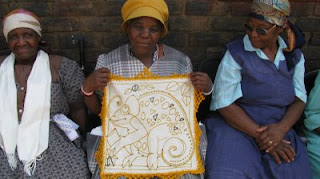
 The Wednesday grannies are more in number than the group I met with at the Baptist church. There were 24 ladies and one gentleman. They usually meet under a sheet of plastic stretched across a junk-wood frame between two buildings, but the man who owns the space forgot to move his car this Wednesday morning. So the ladies lined up their plastic garden chairs along the wall of the neighboring house where the shadow fell a few feet into the brick drive.
 Twenty-five people all in a row make quite a line. I stood in the sun and read my stories, walking from one end of the line to the other to be sure everyone saw the pictures and understood what was going on. Imelda, who might have translated, was busy heating the mac and cheese and despite their assurances, these ladies didn't seem as educated or fluent in English as the Friday group. I was less confident that they would understand someone merely standing up front talking in a language that wasn't their own. But they laughed appreciatively as Lulama tricked the baboons, the python and the lion and at last made her way home to her mother's arms. They nodded agreement when I explained my reasons for reading with their grandchildren.
When I had finished, one woman asked, "What do you do when the children are older and don't want to read?" Too often the TV stays on all the time, and modern young people don't want to listen to their granny. I will need to think through some appropriate suggestions for reaching the older ones.
I wish I could give every one of these grannies a $2 copy Our Gran. They cooed delightedly when I read it as an example of how a story can help to introduce a sensitive topic. It describes them and all they do for their families. Together they had 129 grandchildren and 49 great-grandchildren, although not all of those were living with the grandparents. And Ruth told me that the lady with the most grandchildren (23) wasn't even there!
Imelda and Selina brought plates of mac and cheese as fast as the capacity of Imelda's small oven allowed. I found a seat in the shade along the wall, reminding myself how nice the African sun should feel after a Northern winter, and how good my tan would look when I returned to Wisconsin. After all, at this altitude the sun isn't what it can be in the lowfeldt.
The woman next to me pulled a small plastic storage container out of her bag, and slid most of her portion of mac and cheese into it to take home.
"For my grand daughter," she explained, saving only the last couple bites for herself.

Saturday, March 14, 2009
Alexandra Grannies
There was a line hundreds long outside the Alexandra fire station.
"That will affect numbers at the grannies support group," my SIM colleague, Ruth Maxwell, told me as we drove by. We suspected the government was handing out food packages and making sure everyone knew which party was in control of this bounty before next months elections.
 Sure enough, numbers were down. Eventually six older women and one man joined the young ladies who work in home care in the area. One woman brought a grandchild who hadn't gone to school that day due to a tummy upset. Some spoke fluent English, although they lapsed into South Sotho when they spoke among themselves. All understood me well enough to laugh heartily at Marjorie van Heerden's Lulama's Long Way Home and nod their heads to my reasons why reading with their grandchildren was a good idea. (See Reading with Grannies .) They even knew the locations of, not one, but two public libraries within walking distance, and we talked about how to get a library card and borrow books for free as long as you return them on time. (South African libraries are still into heavy overdue fines.)
Ruth had told me that one of the women, Nkele, is an acknowledged artist in the community. Her creativity was obvious as Ruth brought out a box of fabric scraps and asked for ideas how they could be used to raise money for the group. I am going to be talking with Nkele about possibly illustrating one of my stories. Ruth has contacts who know how to write grants for such projects, and using a local artist will make it a good project for the church.
 While the ladies sorted through the scrap box and exclaimed at their finds, Bonolo, Nkele's nine-year-old granddaughter, poured over the sample books I had brought. She told me her name means 'soft'. I thought how soft and cuddly her parents must have found her when she was new-born. Now her father is dead and her mother is very sick--an all-too-common story. Bonolo has a loving grandmother, reaching out to her neighbors and fighting for her family's future. That's why Ruth, Selina, Octavia and others consider it a privilege to stand along side them in their struggle.
"That will affect numbers at the grannies support group," my SIM colleague, Ruth Maxwell, told me as we drove by. We suspected the government was handing out food packages and making sure everyone knew which party was in control of this bounty before next months elections.
 Sure enough, numbers were down. Eventually six older women and one man joined the young ladies who work in home care in the area. One woman brought a grandchild who hadn't gone to school that day due to a tummy upset. Some spoke fluent English, although they lapsed into South Sotho when they spoke among themselves. All understood me well enough to laugh heartily at Marjorie van Heerden's Lulama's Long Way Home and nod their heads to my reasons why reading with their grandchildren was a good idea. (See Reading with Grannies .) They even knew the locations of, not one, but two public libraries within walking distance, and we talked about how to get a library card and borrow books for free as long as you return them on time. (South African libraries are still into heavy overdue fines.)
Ruth had told me that one of the women, Nkele, is an acknowledged artist in the community. Her creativity was obvious as Ruth brought out a box of fabric scraps and asked for ideas how they could be used to raise money for the group. I am going to be talking with Nkele about possibly illustrating one of my stories. Ruth has contacts who know how to write grants for such projects, and using a local artist will make it a good project for the church.
 While the ladies sorted through the scrap box and exclaimed at their finds, Bonolo, Nkele's nine-year-old granddaughter, poured over the sample books I had brought. She told me her name means 'soft'. I thought how soft and cuddly her parents must have found her when she was new-born. Now her father is dead and her mother is very sick--an all-too-common story. Bonolo has a loving grandmother, reaching out to her neighbors and fighting for her family's future. That's why Ruth, Selina, Octavia and others consider it a privilege to stand along side them in their struggle.
Subscribe to:
Posts (Atom)

 Posts
Posts

